
Disclaimer: The information provided in this article is intended solely for research and educational purposes. The use of ELF binary packers, including their creation, analysis, or modification, should be conducted responsibly and ethically. Any application of this knowledge for malicious activities, unauthorized use, or violation of laws and regulations is strictly discouraged. The author assumes no responsibility for any misuse of the information presented. Readers are encouraged to adhere to all applicable laws and ethical guidelines when conducting their research.
Introduction
A packer is a type of software that is commonly used by malware authors and hackers to compress or encrypt a malicious executable file. The primary purpose is to evade a malware-infected file from being detected by an antivirus software due to obfuscation. Also, it also makes the reverse engineering process more difficult for security researchers.
Even if the term “packer” is implicitly associated with some form of compression, it also nowadays refers to any form of obfuscation, including encryption, anti-debugging, anti-VM, etc.
In this article, we gonna explore the creation of a simple ELF binary packer. For the sake of simplicity, our protector will use a simple XOR encryption algorithm and no compression layer. Needless to say that this packer would not resist serious analysis.
Prior knowledge of Linux ELF executable format, x86-64 assembly, and C programming is required. This article will not cover these topics in detail.
Architecture overview
The packer is composed of two main components. They must have agreed-upon mechanism(s).
The protector
The protector is the program that applies the protection to the target binary. This is a standalone program that takes the target binary as input and outputs a freshly packed binary.
| |
The “runtime engine” or “stub”
The stub is responsible for deobfuscating the protected binary. It sole purpose is to decrypt the binary and pass control to the decrypted code.
Usually, the stub lives into the protected binary, and necessary modifications to the executable binary format have to be done by the protector. It does not have the luxury of using the standard C library : it must be self-sufficient. Following code example will use x86-64 assembly and the follow the System V ABI. Since we are working on Linux, the ELF format will be used.
Packing and executing a target binary with woody_woodpacker
Our packed executable will print ....WOODY.... to signal that the binary has been packed. In the following example pack_me is a simple ELF binary that prints Hello World! to the standard output.
| |
Stub
Starting here, the term stub and parasite will be used interchangeably.
Injecting decryption routine
In Unix Viruses, Silvio Cesare, an Australian security researcher, begins his paper by describing a crude but smart form of infection :
An interesting, yet simple idea for a virus takes note, that when you append one executable to another, the original executable executes, but the latter executable is still intact and retrievable and even executable if copied to a new file and executed.
This is a simple demonstration, host will be appended to parasite. Simply appending host will not change the ELF file structure of parasite, thus parasite will execute as normal.
| |
Now, if the parasite keeps track of its own length, it can copy the original host to a new file, then execute it like normal, making a working parasite and virus. The algorithm is as follows:
- execute parasite work code.
- lseek to the end of the parasite.
- read the remaining portion of the file that contains the host.
- write to a new file.
- execute the new file.
lseek to the end of the parasite -> a parasite can actually open itself using the /proc/self symbolic link and the open syscall :
| |
What Silvio describes here, is a format agnostic way of infecting a binary. It does not rely on injection of parasite code within a particular executable format : the host is appended to the end of the parasite. It does not require parsing ELF (on Linux) segments or PE (on Windows) sections to find a place for infection. However, we are working in a Linux environnement in this article.
This method has avantages and some tradeoffs :
- very reliable : parasite infection method does not rely on the host’s file format. Binary patching is not required.
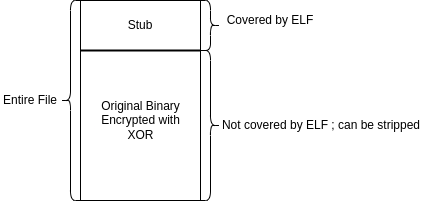
- not strip safe : since the host is appended at the end of the file, it is not described by any sections or segments by the ELF file format. Consequently, running
stripon the infected binary will break the infection. - hide the host ELF : running
readelffor example on the packed binary will reveal only the stub segments, sections, and symbols.
Schematicaly, our packed binary file will look like this :
Passing control back to the host binary
It is the stub responsability to decrypt the host, and load it into memory. The process of loading a binary without using the exec syscall family is commonly called the user-land exec and has been documented by the grubq in this paper. This term refers to the fact that the ELF loading is done in user-land, without kernel help.
However, it is nevertheless possible for a stub to rely on the kernel exec functions and Silvio indicate that the original binary should be write to a new file and be executed. We can easily think of an example : the stub writes to tmp/bin and use the execve syscall on that tempory file.
The obvious disavantage of this technique is that it leaves traces in the filesystem. Fortunatly, the Linux kernel developers had developped a few syscalls since Silvio’s article that might help us to be stealthy.
execveat
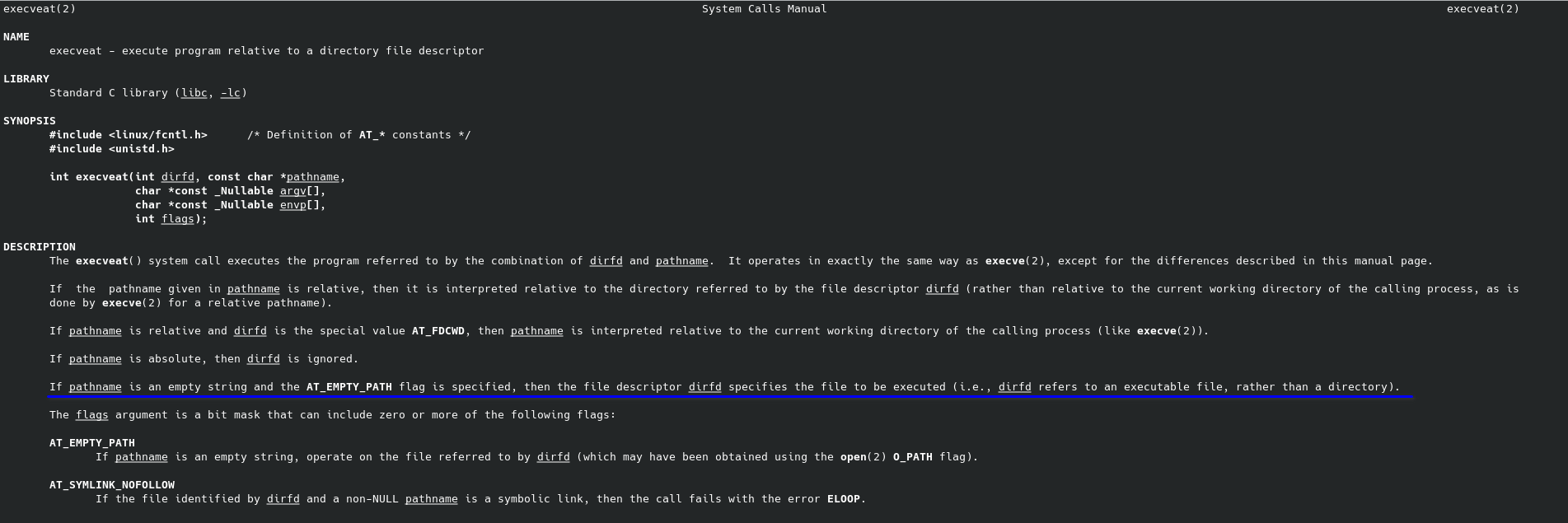
execveat is a syscall that was added in Linux 3.19, Sun, 8 Feb 2015.
The man page from libc execveat describes the syscall :
With this in mind, we can refine Silvio’s algorithm :
- execute parasite work code
- lseek to the end of the parasite
- call execveat
Could that be that easy ? The answer is no, but we are close. The problem is that the execveat syscall does not care about the file offset of the file descriptor fd.
| |
This will basically result in an infinite loop. execveat will execute the parasite again and again, without taking into account the fact that we moved the file offset with lseek. We need to have a file descriptor dedicated to the host code. A file descriptor is an abstraction, and it doesn´t necessaraly refers to a file stored on the filesystem.
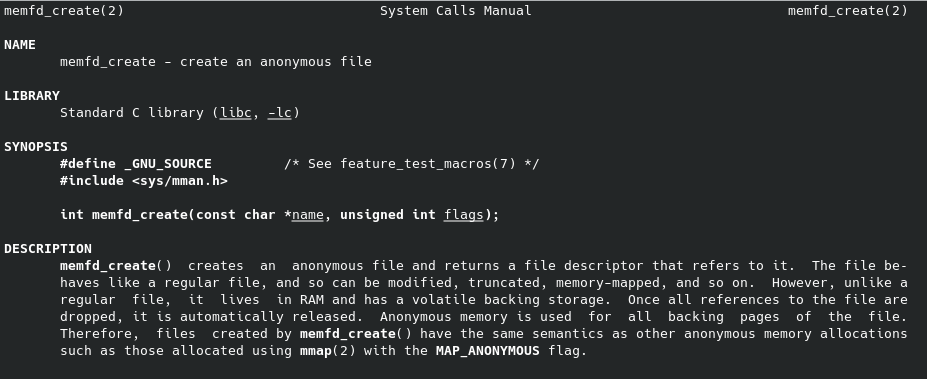
memfd_create
This is what the man page have to say about the memfd_create syscall :
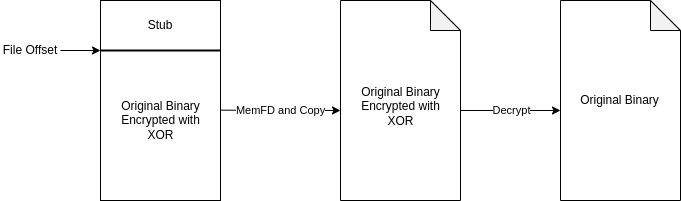
Our algorithm ends up as follow, including the host decryption :
- execute parasite work code
- lseek to the end of the parasite
- create a memory file descriptor
- copy host from parasite to memory file descriptor
- decrypt host code
- call execveat on the memory file descriptor
| |
The sendfile syscall do the copy part in kernel space. This is more efficient than a read write combo, that transfers data from user space and kernel space multiple times.
Our stub is almost finished : since the host is crypted, we need to decrypt it prior to execution. We can access the memory area of the memory file descriptor by using mmap.
Putting it together
Instead of using C code, we will write the stub in x86 64 assembly without using libc syscall wrapper. This will allow us to have smallest size footprint on the final stub executable.
Do note that the protector will have to patch the key and the payload_size in the .rodata section. stub_size must be determined manually with ls -l stub once the stub is compiled.
Once the stub is assembled and linked, we can dump each byte of the stub into a C array with the following command :
| |
This array will be used by the protector to write the stub into the packed binary.
Finding offsets of key and payload_size in the stub
Before, compile the stub with
nasm -f elf64 woody.s -o woody.o && ld woody.o -znoseparate-code -o woody.
To know the offset of the key and payload_size variables in the .rodata section, we can use readelf --symbols ./woody and look for the symbol addresses.
| |
The Value column indicates the virtual address of each symbol. To get the offset in file of the .rodata section :
| |
There is a single segment in our stub binary, that loads both the .text and .rodata sections. The segment starts at offset 0x0 in file, thus the offset of each symbol in the file is simply its virtual address minus the segment virtual address 0x400000.
For the key : 0x4001c7 - 0x400000 = 0x1c7
For the payload_size : 0x4001bf - 0x400000 = 0x1bf
Protector
The protector algorithm is as follows :
- open the binary to pack
- patch the stub shellcode to set the
keyfor decryption and the size of the payload to protect. - encrypt the target binary with the same
key. - write the stub followed by the encrypted target binary to the output file.
Our protector will takes the target binary as argument and will output the packed binary named woody. Optionally, a second argument can be provided to set the XOR key used for encryption/decryption. If no key is provided, a default key will be randomly generated from /dev/urandom.
This header file contains the necessary offsets for the symbols previously discussed.
Patching the stub with the key and payload size is just a matter of writing at the right offset.
This is the complete protector code :
Building and testing
The full project can be found on GitHub.
| |
Now, woody should act as a packed version of /bin/ls, and print ....WOODY.... prior to executing the real /bin/ls code.
| |
We can even see the syscalls used by the stub with strace :
| |
From now, the rest of the execution is done by the host binary, which is /bin/ls in our case.
| |
Conclusion
In this article, we have explored the creation of a simple ELF binary packer using XOR encryption. We have discussed the architecture of the packer, including the protector and the stub components. The protector is responsible for applying the protection to the target binary, while the stub is responsible for decrypting and executing the protected binary.
Packer can be hugely more complex than what we have seen here. The technique presented here would not last a few hours against a determined reverse engineer.